Medically reviewed by Dr. Priya Prakash (Rheumatologist, board certified) | Last updated: March 20, 2026
What Is De Quervain’s Tenosynovitis? Symptoms, Causes, Diagnosis & Treatment
De Quervain’s tenosynovitis is a painful condition involving the tendon sheath on the thumb side of the wrist. It usually affects the tendons that help move the thumb and causes pain near the base of the thumb, especially with gripping, pinching, lifting, or twisting motions. Most cases improve with splinting, rest, ice, anti-inflammatory treatment, and sometimes corticosteroid injection, while surgery is reserved for persistent symptoms.
If you’re searching what is De Quervain’s tenosynovitis, the simplest answer is that it is an overuse-related or mechanical tendon-sheath problem on the thumb side of the wrist. The condition commonly causes pain, swelling, and difficulty using the thumb for daily activities such as lifting a child, opening jars, texting, gripping tools, or repeated wrist movement. A hand specialist, rheumatologist, orthopedist, sports medicine physician, or primary care clinician can help confirm the diagnosis and create an individualized De Quervain’s treatment plan based on symptom severity and response to conservative care.
Quervain
De Quervain’s often develops gradually and may be linked to repetitive hand use, new lifting demands, or postpartum strain. It is especially common in people who repeatedly grasp, pinch, wring, or move the thumb and wrist together. Because the pain is near the base of the thumb, it can sometimes be confused with thumb arthritis, wrist tendinitis, nerve irritation, or other hand conditions.
Table of Contents
- What Is De Quervain’s Tenosynovitis? Simple medical definition
- De Quervain’s at a glance
- Common De Quervain’s patterns
- De Quervain’s symptoms (what it feels like)
- Causes & risk factors
- How De Quervain’s is recognized
- Comorbidities & related conditions
- Prognosis (what to expect long-term)
- Understanding De Quervain’s: complete condition explanation
- De Quervain’s vs thumb arthritis
- Diagnosis: exam, testing, imaging
- Treatment: symptom relief + long-term recovery
- Treatment targets (pain, motion, grip function)
- De Quervain’s vs carpal tunnel syndrome (quick table)
- When to seek urgent care
- Downloadable De Quervain’s symptom checklist
- Related conditions (internal links)
- FAQs
- Conclusion + next steps
What Is De Quervain’s Tenosynovitis? Simple Medical Definition
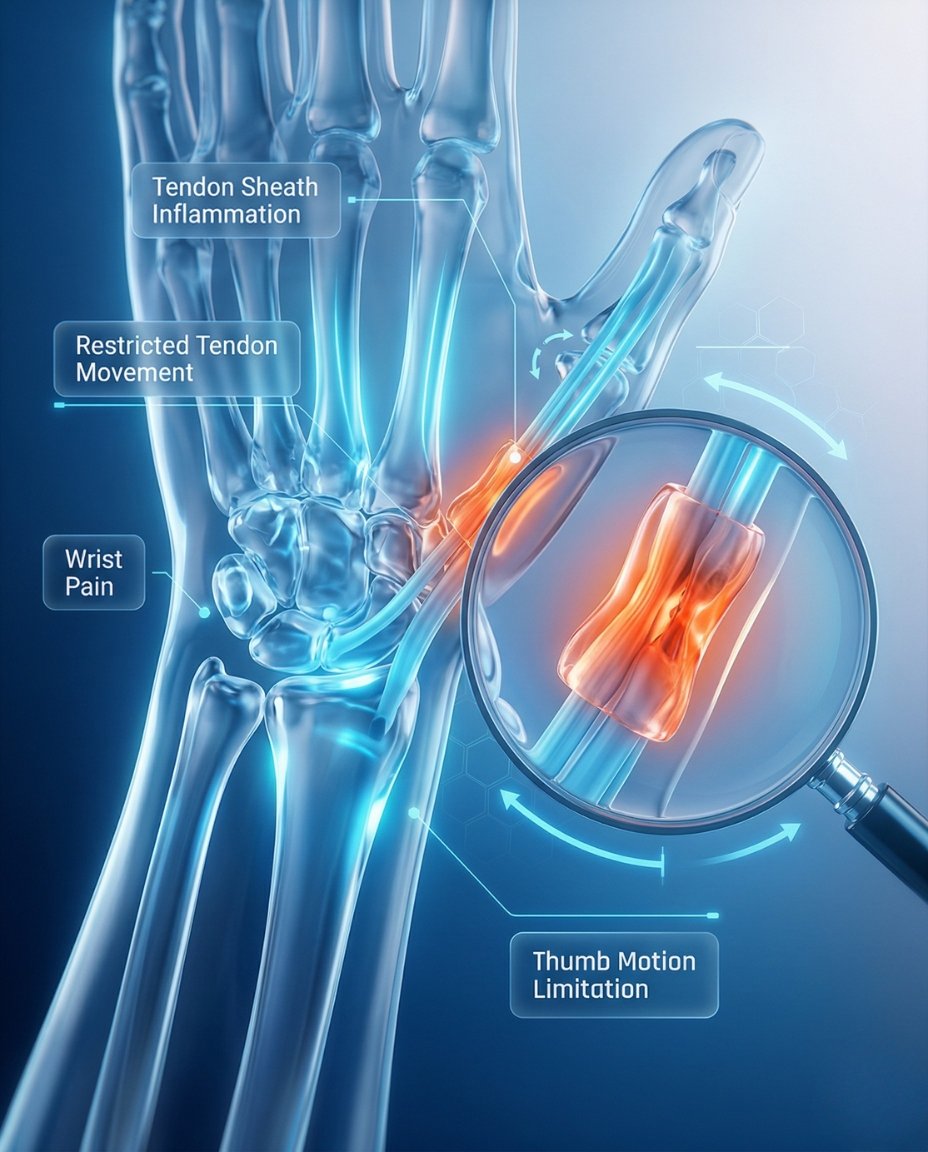
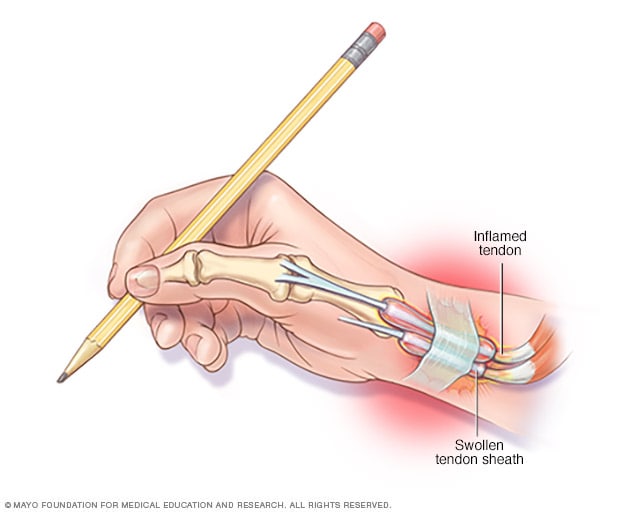
De Quervain’s tenosynovitis is a painful stenosing tenosynovial disorder affecting the first dorsal compartment of the wrist. In short, clinically, what is De Quervain’s tenosynovitis? It is a condition in which the tendon sheath around the abductor pollicis longus and extensor pollicis brevis tendons becomes thickened and irritated, making thumb and wrist motion painful.
De Quervain’s at a Glance
Thumb-side wrist pain Pain is usually felt near the base of the thumb
Grip and pinch pain Daily tasks such as lifting, opening jars, or texting can hurt
Swelling may occur Some people notice fullness or tenderness over the tendon area
Overuse is common Repetitive thumb and wrist motion often triggers symptoms
Usually treatable without surgery Splinting, rest, and injection often help
De Quervain’s is a tendon-sheath problem near the thumb, not a true joint disease, although it can feel similar to other hand problems.
Common De Quervain’s Patterns
De Quervain’s usually presents as a local mechanical tendon problem, but the way it starts can vary. Some patients develop symptoms after a sudden increase in hand use, while others notice gradual worsening over weeks from repetitive work, childcare, sports, or device use. Clinicians often think about the condition by whether it is early and mild, persistent and function-limiting, postpartum-related, or resistant to conservative treatment.
Early overuse pattern New thumb-side wrist pain after repetitive strain
Postpartum pattern Common after repeated lifting of an infant or baby gear
Persistent pattern Ongoing pain despite rest or home treatment
Mechanical-irritation pattern Pinching, wringing, texting, or lifting repeatedly worsens symptoms
Injection- or surgery-refractory pattern Symptoms continue despite conservative treatment
De Quervain’s symptoms (what it feels like)
Typical De Quervain’s symptoms include pain near the base of the thumb, swelling, tenderness, and pain with grasping or wrist movement. Patients often describe sharp pain when lifting objects, opening jars, wringing towels, picking up a child, or moving the thumb away from the hand. Some people also notice a sticking or catching sensation in the thumb and reduced grip strength because pain limits normal use.
Base of thumb • Thumb-side wrist • First dorsal compartment • Grip and pinch movement zone
Repetition, lifting
Thumb strain
Thickening
Tendon entrapment
Pain, swelling
Grip difficulty
Confirm cause
Restore use
Wheel shows a simplified pathway: repetitive thumb-wrist strain → tendon sheath thickening and irritation → painful movement and reduced hand function → treatment and recovery.
Images for patient education
Thumb-side wrist pain
Pinch and grip difficulty
Postpartum lifting strain
Causes & risk factors
De Quervain’s is commonly linked to repetitive thumb and wrist motion, especially forceful pinching, grasping, lifting, and wringing. It can also occur during late pregnancy or the postpartum period, likely because of hormonal influences and the repeated lifting patterns involved in infant care. Any activity that repeatedly irritates the tendons passing through the first dorsal compartment can contribute to symptoms.
- Repetitive thumb and wrist use
- Gripping, pinching, lifting, wringing, or texting motions
- Postpartum or infant-lifting strain
- Work or sport activities requiring repeated thumb deviation
- Tendon sheath thickening and irritation
- Recurrence if the triggering movement pattern continues
Evidence-based references (guidelines + high-quality sources)
General patient education: Mayo Clinic. Diagnosis and treatment: Mayo Clinic diagnosis and treatment. Clinical overview: Cleveland Clinic.
How De Quervain’s Is Recognized
De Quervain’s is usually recognized by its characteristic location and pain pattern. Clinicians often suspect it when there is tenderness over the thumb-side wrist and pain that increases with thumb motion, gripping, or ulnar deviation of the wrist. A focused hand exam is often enough, though imaging may be used when the diagnosis is unclear or another wrist problem is suspected.
Pain near the base of the thumb
Tenderness over the first dorsal compartment
Pain with grasping, pinching, or lifting
Swelling or thickening at the thumb-side wrist
Positive provocative exam such as Finkelstein-type testing in the right clinical setting
No primary joint destruction required to explain symptoms
Comorbidities & related conditions
De Quervain’s can overlap with other hand and wrist conditions, especially when symptoms have been present for a long time. It may coexist with thumb carpometacarpal arthritis, general tenosynovitis, repetitive strain syndromes, or inflammatory conditions affecting the hand. Recognizing related problems helps explain why some patients recover quickly while others need more than one form of treatment.
- Thumb carpometacarpal arthritis
- Other tendon irritation around the wrist
- Repetitive strain or overuse syndromes
- Postpartum overuse pattern
- Reduced grip strength because pain limits use
- Functional limitations in childcare, lifting, sports, or work
Prognosis (what to expect long-term)
Most patients improve with conservative treatment, especially when care begins early and the triggering movements are reduced. Symptoms often settle over several weeks, and many patients recover well with splinting, rest, or corticosteroid injection. Untreated or persistent cases can continue to limit thumb motion and grip function, and some patients eventually need surgery.
Early treatment often improves symptoms within weeks.
Conservative treatment works for many patients.
Persistent or recurring cases may need injection or surgical release.
Understanding De Quervain’s: Complete Condition Explanation
Two important thumb tendons travel through a tight tunnel on the thumb side of the wrist. When the tendon sheath in that area thickens or becomes irritated, the tendons do not glide smoothly and movement becomes painful. This is why actions such as gripping, pinching, lifting, or bending the wrist can trigger sharp discomfort.
What happens in the tendon sheath?
The tendon covering becomes thickened and crowded, which increases friction as the tendons move. Over time, even basic hand tasks can reproduce the pain because the same structure is stressed repeatedly. This mechanical problem explains why splinting and activity modification often help, especially in the early stages.
Repetitive thumb-wrist strain → sheath thickening and tendon entrapment → pain with pinch, grip, lifting, and wrist deviation.
De Quervain’s vs thumb arthritis
De Quervain’s and thumb arthritis can both cause pain near the base of the thumb, but they are not the same condition. De Quervain’s affects the tendons and their sheath, while thumb arthritis affects the carpometacarpal joint itself. The distinction matters because the exam findings, imaging, and best treatment plan can be different.
De Quervain’s pain is often linked to tendon motion and thumb-side wrist tenderness.
Thumb arthritis is more joint-centered and often worsens with pinch and joint loading.
Correct diagnosis helps decide whether splinting, injection, hand therapy, or arthritis-focused care is most appropriate.
Diagnosis: exam, testing, imaging
De Quervain’s is usually diagnosed from the history and physical examination. Clinicians often use a focused exam that checks tenderness over the first dorsal compartment and pain with certain thumb and wrist maneuvers. Imaging is not always necessary, but ultrasound or other studies may help when symptoms are persistent or another condition is being considered.
Tests often ordered during initial evaluation
Most cases are diagnosed clinically, but some patients need further evaluation.
- Physical examination focused on tenderness, grip pain, and provocative thumb-wrist maneuvers.
- X-ray when thumb arthritis, fracture, or another structural issue is possible.
- Ultrasound when the diagnosis is unclear or tendon-sheath thickening needs confirmation.
- Functional assessment of pinch, grip, lifting, and work or childcare triggers.
- Referral to hand or orthopedic specialists for persistent symptoms or surgical planning.
Treatment: symptom relief + long-term recovery
Effective De Quervain’s treatment has two main goals: reduce tendon-sheath irritation and restore comfortable thumb and wrist function. Many patients improve with a thumb spica splint, rest, ice, and anti-inflammatory treatment. Persistent symptoms may respond to corticosteroid injection, and surgery is usually reserved for people who do not improve with appropriate nonsurgical care.
1) Symptom control (short-term relief)
Initial treatment often includes a splint or brace that keeps the thumb and wrist more still, along with rest and ice. Over-the-counter NSAIDs may help reduce pain and swelling when appropriate. Avoiding repeated thumb pinching, wringing, lifting, and awkward wrist deviation is also important during healing.
2) Long-term management (preventing recurrence)
Long-term care often includes hand therapy, stretching, ergonomic changes, and better movement patterns for work, childcare, sports, or device use. Corticosteroid injection is a common next step when symptoms continue despite splinting and rest, and many patients improve significantly after injection. Surgery may be recommended when symptoms remain severe or recurrent and conservative treatment does not provide lasting relief.
3) When additional treatment is needed
- Hand therapy can improve mechanics, reduce strain, and restore safe movement.
- Corticosteroid injection may reduce sheath swelling and help recovery in persistent cases.
- Activity modification is essential if the same motion pattern keeps reproducing the pain.
- Surgical release may be considered when nonsurgical treatment fails.
- Recovery is usually best when treatment begins early and recurrence triggers are corrected.
Treatment targets (pain, motion, grip function)
In De Quervain’s, treatment targets focus on reducing pain, improving tendon glide, and restoring grip and thumb use. Clinicians track thumb-side wrist tenderness, pain with lifting or pinching, swelling, functional hand use, and symptom recurrence. Good control means the patient can grip, lift, text, carry objects, or care for a child with less pain and better hand confidence.
| Target area | What your clinician tracks | What “on target” can look like |
|---|---|---|
| Pain control | Tenderness, pain with pinch, lifting, texting, jar opening, and thumb motion | Less pain during daily tasks |
| Movement recovery | Thumb motion, wrist deviation pain, swelling, stiffness | Smoother motion with less irritation |
| Function and recurrence prevention | Grip strength, childcare or work triggers, repeat strain patterns, response to splint/injection | Better hand use and fewer repeat flares |
Case Study 1 (Example)
Patient developed pain along the thumb side of the wrist, worsening with gripping, lifting, or twisting movements like opening jars. Evaluation suggested De Quervain’s tenosynovitis rather than wrist- sprain or ligament injury.
De Quervain’s vs carpal tunnel syndrome (quick comparison)
De Quervain’s and carpal tunnel syndrome both affect the hand and wrist, but they involve different structures. De Quervain’s is a tendon-sheath problem on the thumb side of the wrist, while carpal tunnel syndrome is a nerve-compression problem involving the median nerve. The distinction matters because numbness and tingling suggest nerve compression, while localized thumb-side pain with thumb motion points more toward De Quervain’s.
| Feature | De Quervain’s tenosynovitis | Carpal tunnel syndrome |
|---|---|---|
| Main structure involved | Thumb tendons and tendon sheath | Median nerve in the carpal tunnel |
| Main symptom pattern | Pain near the base of the thumb and wrist | Numbness, tingling, weakness in the hand |
| Pain with thumb motion | Common | Not the defining feature |
| Night numbness | Not typical | Common |
| Treatment focus | Splinting, rest, injection, tendon-sheath care | Nerve pressure relief and wrist-position management |
When to seek urgent care
- Severe swelling, trauma, or sudden inability to move the thumb or wrist.
- Numbness, marked weakness, or concern for a nerve problem rather than a tendon problem.
- Signs of infection such as redness, warmth, fever, or rapidly worsening pain.
- Symptoms that do not improve after several weeks of splinting and activity modification.
Call Now for De Quervain’s Care
⭐ Google Rating: 4.7/5 (184 reviews) • Insurance accepted: Most major plans (verify with office).
Patient testimonial: “I thought it was just wrist strain from lifting, but the pain near my thumb kept getting worse. The team explained De Quervain’s clearly and helped me finally calm it down.”
Call Now: (352) 717-0603 Request AppointmentClinic Address
Rheumatology Care Associates PLLC (RCA)
2611 S US Hwy 27, Clermont, FL 34711
Email: info@rheumatologycareassociates.com
Office hours: Mon 8:30AM–5:00PM; Tue 8:30AM–5:00PM; Wed 8:00AM–3:30PM; Thu 8:30AM–5:00PM; Fri 9:00AM–1:30PM.
Related conditions (internal links)
FAQ
Conclusion
De Quervain’s tenosynovitis is a common and treatable cause of thumb-side wrist pain. If you have pain near the base of the thumb that worsens with gripping, lifting, pinching, or childcare-related hand use, a medical evaluation can help confirm the diagnosis and start the right treatment plan.
Disclaimer: This article is for educational purposes and does not replace professional medical advice. Always seek prompt care for severe swelling, numbness, weakness, trauma, or signs of infection.
© 2026 Rheumatology Care Associates. All rights reserved.