Medically reviewed by Dr. Priya Prakash (Rheumatologist, board certified) | Last updated: March 20, 2026
What Is Tennis Elbow? Symptoms, Causes, Diagnosis & Treatment
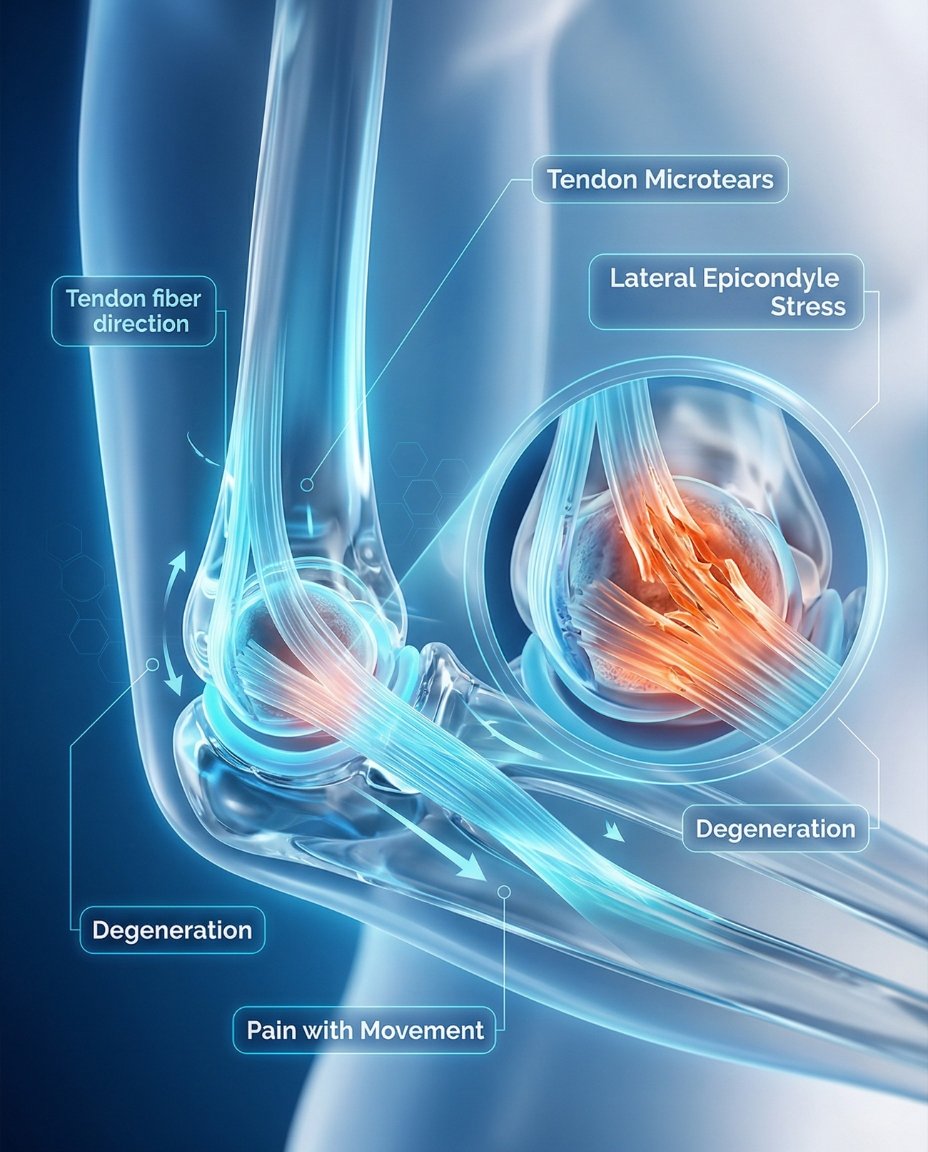
Tennis elbow is a painful condition affecting the tendons attached to the lateral epicondyle on the outside of the elbow. It usually develops from repetitive gripping, lifting, wrist extension, or forearm use that irritates the tendon origin over time. Most cases improve with rest, activity modification, bracing, pain relief, and targeted therapy, while surgery is usually reserved for symptoms that do not improve after many months of conservative care.
If you’re searching what is tennis elbow, the simplest answer is that it is an overuse tendon problem on the outer side of the elbow. Even though the name sounds sports-specific, many people develop it from work tasks, tools, lifting, repeated mouse use, racquet sports, or repetitive forearm strain. A rheumatologist, orthopedist, sports medicine physician, or primary care clinician can help confirm the diagnosis and create an individualized tennis elbow treatment plan based on severity, job demands, and how long symptoms have been present.
elbow
Tennis elbow often starts gradually and may first feel like mild soreness when gripping or lifting. Over time, the pain may spread down the forearm or make daily tasks such as shaking hands, turning a doorknob, pouring from a kettle, or holding a pan more difficult. Because outside-elbow pain can also come from nerve problems, arthritis, referred neck pain, or other tendon issues, getting the diagnosis right matters.
Table of Contents
- What Is Tennis Elbow? Simple medical definition
- Tennis elbow at a glance
- Common tennis elbow patterns
- Tennis elbow symptoms (what it feels like)
- Causes & risk factors
- How tennis elbow is recognized
- Comorbidities & related conditions
- Prognosis (what to expect long-term)
- Understanding tennis elbow: complete condition explanation
- Tennis elbow vs golfer’s elbow
- Diagnosis: exam, imaging, testing
- Treatment: symptom relief + long-term recovery
- Treatment targets (pain, grip, forearm function)
- Tennis elbow vs radial tunnel syndrome (quick table)
- When to seek urgent care
- Downloadable tennis elbow symptom checklist
- Related conditions (internal links)
- FAQs
- Conclusion + next steps
What Is Tennis Elbow? Simple Medical Definition
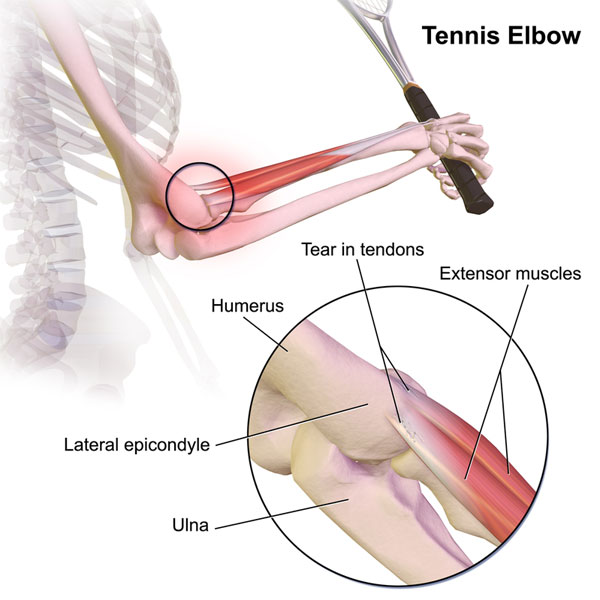
Tennis elbow, also called lateral epicondylitis or lateral epicondylosis, is a tendinopathy involving the common extensor tendon origin at the lateral epicondyle of the humerus. In short, clinically, what is tennis elbow? It is a painful overuse condition in which repetitive load on the wrist extensor tendons, especially around the extensor carpi radialis brevis region, causes tendon irritation and degeneration at the outer elbow.
Tennis Elbow at a Glance
Outer elbow pain Pain is usually centered at the bony area on the outside of the elbow
Grip makes it worse Grasping, lifting, twisting, or shaking hands can trigger pain
Usually overuse-related Repetitive forearm activity is a common trigger
Not just a tennis injury Work and daily-life activities often cause it
Conservative care usually works Most patients improve without surgery
Tennis elbow is usually a tendon-overload problem, not a major joint injury, although it can become very limiting in daily life.
Common Tennis Elbow Patterns
Tennis elbow may be mild and recent, or chronic and function-limiting. Some patients notice it after a change in racket use or a new exercise routine, while others develop it slowly from typing, tools, lifting, repetitive work, or home tasks. Clinicians often think about the condition by whether it is early and activity-related, chronic and degenerative, or overlapping with nerve irritation or other elbow disorders.
Early overuse pattern Mild soreness with gripping or wrist extension after repetitive activity
Work-related pattern Pain linked to tools, lifting, mouse use, or repetitive forearm work
Sport-related pattern Racquet mechanics, grip size, or sudden training change trigger symptoms
Chronic pattern Ongoing pain and weakness limit daily tasks for weeks or months
Overlap pattern Tendon pain exists alongside radial tunnel syndrome or other elbow conditions
Tennis Elbow symptoms (what it feels like)
Typical tennis elbow symptoms include pain or burning on the outside of the elbow, tenderness, and weaker grip strength. Many patients feel pain when lifting a mug, opening a jar, turning a key, shaking hands, carrying a bag, or extending the wrist against resistance. The pain may stay local to the lateral elbow or spread down the forearm, especially after repeated use.
Outside of elbow • Lateral epicondyle • Upper forearm • Grip and wrist-extension zone
Gripping, lifting
Repetitive strain
Microdamage
Degeneration
Outer elbow pain
Grip weakness
Confirm cause
Restore function
Wheel shows a simplified pathway: repetitive forearm loading → extensor tendon overload → pain at the lateral elbow and weaker gripping → rehab and recovery.
Images for patient education
Outer elbow pain

Grip pain with daily tasks
Sport and work strain

Causes & risk factors
Tennis elbow is usually caused by repetitive stress on the wrist extensor tendons where they attach on the outer elbow. Repeated gripping, lifting, twisting, backhand stroke mechanics, tool use, or work tasks that load the forearm can all contribute. The condition is often considered more degenerative than purely inflammatory, which is why gradual tendon healing and load management are so important.
- Repetitive wrist extension or gripping
- Racquet sports, tools, manual work, or repetitive mouse use
- Sudden increase in activity or poor technique
- Tendon microtears and degeneration over time
- Middle age is a common risk pattern
- Ongoing strain can prolong healing and recurrence risk
Evidence-based references (guidelines + high-quality sources)
General patient education: Mayo Clinic. Diagnosis and treatment: Mayo Clinic diagnosis and treatment. Clinical overview: Cleveland Clinic.
How Tennis Elbow Is Recognized
Tennis elbow is usually recognized by the location of pain and the movements that trigger it. Clinicians often suspect it when there is tenderness over the lateral epicondyle and pain with resisted wrist extension, gripping, or lifting. A careful exam is important because radial tunnel syndrome, cervical radiculopathy, elbow arthritis, and ligament problems can also cause lateral elbow pain.
Pain on the outer elbow
Tenderness at the lateral epicondyle
Pain with resisted wrist extension or gripping
Symptoms worsened by lifting, twisting, or repetitive forearm use
Relative preservation of the elbow joint itself in many cases
Clinical exam often sufficient unless symptoms are atypical
Comorbidities & related conditions
Tennis elbow may overlap with radial tunnel syndrome, neck-related arm pain, tendon overuse in the wrist, or other repetitive strain conditions. In some patients, work ergonomics, weak forearm conditioning, poor racket mechanics, or repetitive occupational tasks make symptoms more likely to return. Chronic elbow pain can also interfere with sleep, work, sports, and grip-heavy daily activities.
- Radial tunnel syndrome or nerve-related arm pain
- Repetitive strain from work or sports
- Coexisting wrist or forearm overuse symptoms
- Functional limitation in lifting, carrying, typing, or sports
- Recurrence if load management is not corrected
- Reduced grip confidence and forearm endurance
Prognosis (what to expect long-term)
The overall prognosis for tennis elbow is generally good, and most patients improve with conservative treatment. Recovery can take weeks to months because tendon healing is often gradual, especially when the same repetitive trigger continues. Persistent cases may need more structured rehabilitation, injection-based treatment, or surgical review after prolonged failed conservative care.
Many patients improve within months with conservative care.
Recovery is often slower if repetitive strain continues.
Surgery is usually a last resort after prolonged nonoperative treatment.
Understanding Tennis Elbow: Complete Condition Explanation
The tendons that help extend the wrist and stabilize the hand attach near the outer elbow. When those tendons are repeatedly overloaded, small areas of tendon damage and degeneration can develop where they attach to bone. This explains why gripping, lifting, or extending the wrist can reproduce pain even though the elbow joint itself may not be the main problem.
What happens in the tendon?
Instead of a simple one-time injury, tennis elbow often develops from repeated overload that exceeds the tendon’s ability to recover. The tendon tissue becomes painful and less tolerant of force, especially during repeated wrist extension or gripping. This is why progressive loading exercises and activity modification are such important parts of recovery.
Repetitive forearm loading → extensor tendon overload and degeneration → outer elbow pain with grip, lift, and wrist extension.
Tennis elbow vs golfer’s elbow
Tennis elbow and golfer’s elbow are similar overuse tendon conditions, but they occur on opposite sides of the elbow. Tennis elbow affects the lateral side, while golfer’s elbow affects the medial side near the wrist flexor tendon origin. The distinction matters because the provocative movements, exact tendon involved, and rehab emphasis are different.
Tennis elbow hurts on the outside of the elbow and often worsens with wrist extension and gripping.
Golfer’s elbow hurts on the inside and often worsens with wrist flexion or forearm pronation.
Correct diagnosis improves exercise choice, bracing, and activity modification.
Diagnosis: exam, imaging, testing
Tennis elbow is usually diagnosed from the history and physical examination. Imaging is not always needed, but X-rays, ultrasound, or MRI may be used when symptoms are atypical, persistent, or suggest another diagnosis. In selected cases, clinicians may also evaluate for nerve compression or cervical causes if the symptom pattern does not fit a straightforward tendon problem.
Tests often ordered during initial evaluation
Most cases are diagnosed clinically, but some patients need further workup.
- Physical examination with palpation of the lateral epicondyle and resisted wrist-extension testing.
- X-ray when arthritis, fracture, calcification, or another bony problem is possible.
- Ultrasound or MRI when symptoms persist or tendon damage needs further assessment.
- Neck or nerve evaluation when numbness, tingling, or atypical radiation is present.
- Functional assessment of work, sport, grip, and repetitive strain triggers.
Treatment: symptom relief + long-term recovery
Effective tennis elbow treatment has two main goals: reduce tendon irritation and rebuild the tendon’s tolerance to load. Most patients improve with rest from aggravating activity, ice after use, oral or topical pain relievers, bracing, and structured therapy. The exact plan depends on how long symptoms have been present and how much the pain interferes with daily function.
1) Symptom control (short-term relief)
Early treatment usually includes temporary reduction of the painful activity, ice after activity, and over-the-counter pain relievers when appropriate. Counterforce straps or wrist splints may be used in selected patients to reduce stress on the tendon. These measures help calm symptoms, but long-term success usually also requires a rehab plan.
2) Long-term management (healing and recurrence prevention)
Physical or occupational therapy is often central to recovery because it helps rebuild forearm strength, tendon capacity, flexibility, and movement mechanics. Patients may also need ergonomic changes, racket or tool adjustments, and progressive loading exercises to prevent recurrence. In persistent cases, clinicians may consider injection-based options, shock wave therapy, dry needling, or surgical referral depending on the clinical situation.
3) When additional treatment is needed
- Therapy exercises help restore tendon tolerance and grip function.
- Bracing may reduce tendon strain during activity in selected cases.
- Injection-based treatments may be considered when pain persists despite conservative care.
- Surgery is usually considered only after 6 to 12 months of failed nonoperative treatment.
- Correcting repetitive triggers is essential for durable recovery.
Treatment targets (pain, grip, forearm function)
In tennis elbow, treatment targets focus on reducing pain, improving grip strength, and restoring tolerance for daily forearm use. Clinicians track tenderness, pain with gripping or wrist extension, work or sports triggers, brace response, and ability to lift or carry without flare. Good control means the tendon can tolerate force again without repeated pain spikes.
| Target area | What your clinician tracks | What “on target” can look like |
|---|---|---|
| Pain control | Lateral elbow tenderness, pain with grip, twisting, lifting, and wrist extension | Less pain in daily tasks |
| Grip and forearm function | Grip tolerance, endurance, forearm use, sport/work activity response | Stronger and more reliable arm use |
| Recovery and recurrence prevention | Trigger activity patterns, therapy progress, brace use, repeat flares | Better tendon tolerance and fewer relapses |
Case Study 1 (Example)
Patient developed pain on the outer side of the elbow, worsening with gripping, lifting, or repetitive wrist movements. Evaluation suggested tennis elbow rather than elbow- joint arthritis or nerve compression.
Tennis elbow vs radial tunnel syndrome (quick comparison)
Tennis elbow and radial tunnel syndrome can both cause pain on the outside of the elbow, which is why they are sometimes confused. Tennis elbow more classically causes tenderness right at the lateral epicondyle and pain with gripping or resisted wrist extension, while radial tunnel syndrome is a nerve-related pain problem that may be felt slightly farther down the forearm. Distinguishing between them matters because the treatment focus may shift from tendon loading to nerve irritation management.
| Feature | Tennis elbow | Radial tunnel syndrome |
|---|---|---|
| Main structure involved | Common extensor tendon origin | Radial nerve region |
| Pain location | Usually right over the lateral epicondyle | Often slightly farther down the forearm |
| Grip pain | Common | May occur but is less classic |
| Nerve-related features | Not the main feature | Can be more prominent |
| Treatment focus | Tendon load management and rehab | Nerve irritation and compression management |
When to seek urgent care
- Severe pain after trauma, especially with swelling, deformity, or inability to move the arm.
- Numbness, major weakness, or symptoms suggesting nerve injury.
- Fever, redness, or hot swollen elbow suggesting infection.
- Persistent symptoms that significantly limit work or daily function despite several weeks of self-care.
Call Now for Tennis Elbow Care
⭐ Google Rating: 4.7/5 (184 reviews) • Insurance accepted: Most major plans (verify with office).
Patient testimonial: “I thought it was just soreness from work, but the outside of my elbow kept hurting every time I gripped or lifted. The team explained tennis elbow clearly and helped me finally start healing it.”
Call Now: (352) 717-0603 Request AppointmentClinic Address
Rheumatology Care Associates PLLC (RCA)
2611 S US Hwy 27, Clermont, FL 34711
Email: info@rheumatologycareassociates.com
Office hours: Mon 8:30AM–5:00PM; Tue 8:30AM–5:00PM; Wed 8:00AM–3:30PM; Thu 8:30AM–5:00PM; Fri 9:00AM–1:30PM.
FAQ
Conclusion
Tennis elbow is a common and usually treatable cause of pain on the outside of the elbow. If you have pain with gripping, lifting, twisting, or repetitive forearm use, a medical evaluation can help confirm the diagnosis and start the right recovery plan before the condition becomes more limiting.
Disclaimer: This article is for educational purposes and does not replace professional medical advice. Always seek prompt care for trauma, fever, numbness, or major arm weakness.
© 2026 Rheumatology Care Associates. All rights reserved.